Starting with the job, not a list of names
A search for best plumbers in Mesa turns up lists. What you actually want is the job done right on your house, and that shows up in a handful of habits you can see on the visit: the problem gets found before it gets priced, the price comes in writing, the repair gets tested, and you’re left with a record.
Mesa Rooter Works sets up plumbing visits for slab leaks, repipes, water heaters, softeners, drains and sewer lines across Mesa and the East Valley. Here’s what each of those jobs looks like when it’s done properly, so you know what to expect when the plumber arrives.
Finding a slab leak before pricing it
A slab leak repair starts with proof there’s a leak at all. With every fixture off, the meter tells the story: if the small leak indicator keeps turning, water is going somewhere. Next the hot side gets shut off at the water heater to see which line is losing water. Then the plumber narrows the spot with listening gear and pressure testing.
Only when the leak is located does a price mean anything. Then you choose between opening the floor at that spot, rerouting the line through the attic and walls, or repiping. If your slab is post-tensioned, expect that to come up early, because cutting into tensioned concrete is dangerous. The slab leak page walks through that choice.
Testing new water lines before anything closes up
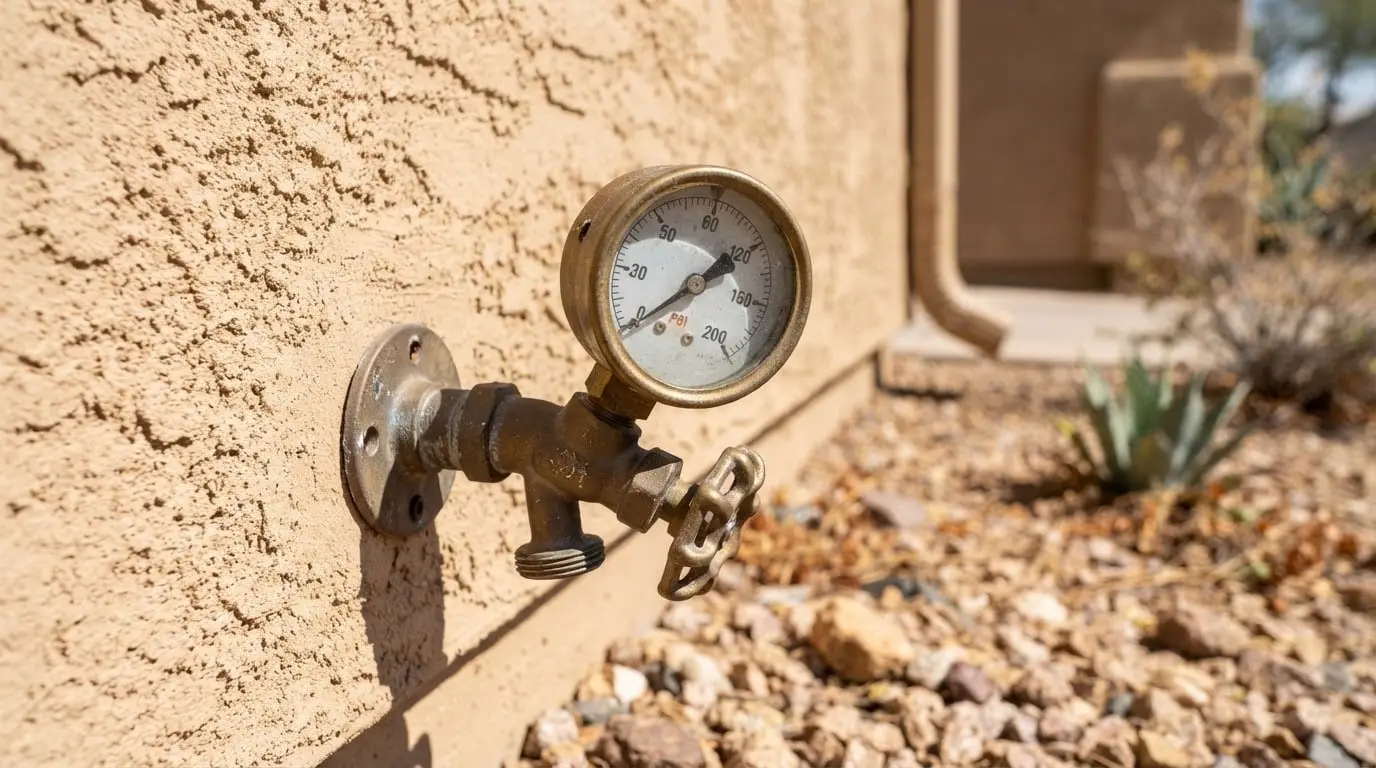
On a reroute or a whole-house repipe, the new pipe gets pressure tested while it’s still exposed. That test is what shows every joint holds. On a repipe you’ll also go over where the new lines will run, how many wall openings to expect and how the drywall gets patched, so the house isn’t full of surprises halfway through.
Where the city requires a permit, the inspection happens while the pipe is still visible. In Chandler, for example, replacing or relocating water supply piping isn’t on the list of permit-exempt repairs. The repiping page covers the full job.
Checking everything around a water heater
The tank is one piece of a water heater job. The rest is where code problems and early failures start, so a careful install checks:
- The drain pan and its line, so a future drip doesn’t end up on the garage floor or in the drywall.
- The relief valve discharge pipe, sized right and run to a safe spot.
- An expansion tank, when the plumbing calls for one.
- The gas line, venting and draft on a gas unit, or the circuit on an electric one.
- The anode rod and a flushing plan, because East Valley water scales up a tank that’s ignored.
Permits follow the local rule. In Mesa, replacing a water heater with one of the same or lesser rating doesn’t need a permit, while a tank-to-tankless gas conversion does. The water heater page and the tankless page have the details.
Sewer video you can keep
When a drain has been snaked more than once in a year, a camera goes in. The line gets cleared, the camera runs from the cleanout toward the city main, and any problem is marked by distance and depth and recorded. You can watch the footage and see exactly what’s being pointed at.
After a repair or replacement, a second camera run shows the new pipe clean and flowing. In Mesa the line from your house to the main is yours to maintain, so that video is worth keeping with the house papers. The sewer camera page explains what the footage shows.
A written price that says what it covers
The price comes in writing and spells out the scope. On a slab leak reroute that means the route, the wall openings and whether drywall patching is in. On a water heater it means the tank, the code items, hauling the old one away and any permit. On a sewer job it means the method, the footage, what gets dug up and what gets put back. You only pay for work you agreed to.
Every job is done by a plumber licensed for that class of work in Arizona; the disclaimer page has the details.
Getting this kind of job on your house
When you call, say what you’re seeing and roughly when the house was built. The visit starts with finding the problem, and the how it works page shows each step from the call to the final test.